Last Updated: January 12th, 2026
As building codes continue to push for greater energy efficiency, designers and contractors in commercial and industrial buildings are increasingly asked to incorporate thick layers of continuous exterior insulation. For many years, spray foam insulation – specifically spray polyurethane foam (SPF) – has been promoted as a high-performance option due to its high R-value and air-sealing properties. However, when SPF is used on the exterior of a building, a series of costs, installation, and weather-related challenges often arise.
In contrast, the Quik-Therm Matrix System offers a streamlined, thermally efficient, and contractor-friendly solution designed for real-world performance in commercial and industrial construction.
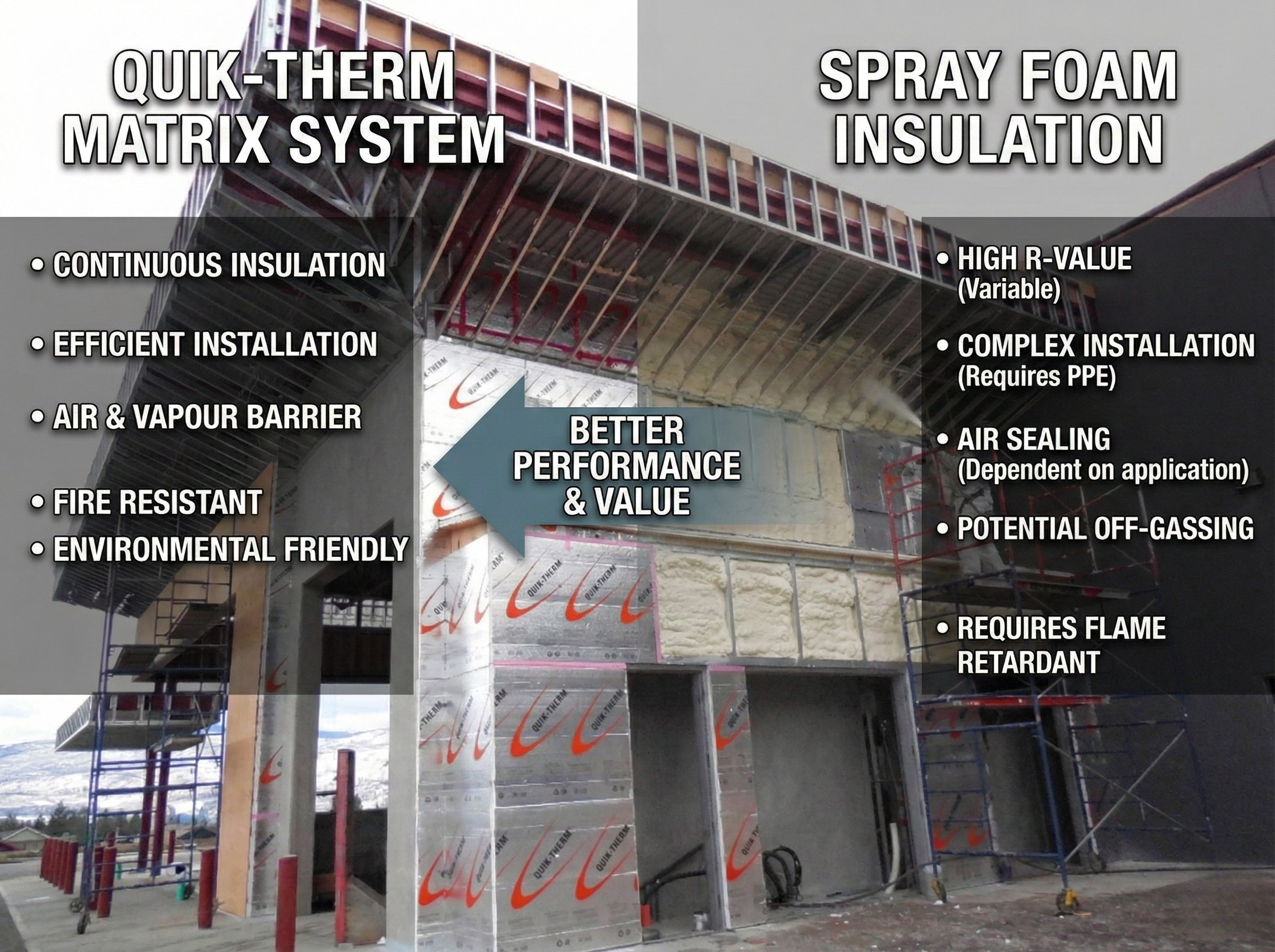
Installation Complexity Of Spray Foam Insulation
While spray foam insulation is widely used in interior surface applications, using spray polyurethane foam on the exterior of commercial buildings introduces complications that many project teams don’t anticipate. SPF – especially closed-cell spray and cell spray foam products – cannot support cladding on their own. As a result, contractors must install expensive attachment systems such as thermal clips or Z-girts.
Added Costs & Thermal Bridging
These systems bring two major drawbacks:
- High Material and Labour Costs
Thermal clips and Z-girts require precise layout and fastening before the polyurethane foam is even applied. For commercial and industrial buildings, the labour burden can be substantial. The added work reduces overall energy efficiency and increases project costs. - Thermal Bridging That Reduces Energy Loss Performance
Steel and aluminum components act as heat bridges, reducing the effectiveness of the insulating layer. This undermines one of the main benefits of spray foam insulation and makes it harder to reduce energy loss in the wall system.
Even though closed-cell spray products have a high R-value, the thermal bridging through metal supports reduces the assembly’s actual performance.
Thickness Limitations Of Spray Polyurethane Foam
As modern codes push toward thick exterior insulation – often 8 to 12 inches / 20.3 to 30.5 cm – contractors face another challenge: Spray polyurethane foam cannot be installed in one thick pass. Because SPF is a chemically reactive product, applying too much at once risks overheating.
SPF Must Be Applied In Lifts Of Only A Few Inches
- Closed-cell spray and cell spray foam must be installed in multiple layers.
- Applying SPF too thickly can lead to scorching or even combustion.
- Multiple lifts increase time, labour, and cost.
This makes spray foam insulation inefficient for achieving very thick R-values on the exterior of commercial buildings and industrial buildings – especially when striving for superior energy efficiency and meaningful reductions in energy loss.
Weather Sensitivity: A Major Limitation In Canadian Climates
Another often-overlooked issue is temperature. Spray polyurethane foam requires minimum ambient and substrate temperatures – typically around 5°C to 10°C, depending on the product. Below that:
- Chemical reactions become unreliable.
- Adhesion decreases.
- R-value is compromised.
- Off-ratio foam becomes more likely.
Given Canada’s long, cold seasons, SPF on the exterior becomes risky or requires costly heated enclosures. For many commercial buildings, this becomes a scheduling and financial burden.
The Matrix System, however, is not dependent on temperature-sensitive chemical reactions, making it far more practical year-round.
The Quik-Therm Matrix System: Thick, High-Performance Assemblies Made Simple
The Quik-Therm Matrix System was engineered to overcome the installation and cost challenges inherent to spray foam insulation on exterior surfaces:
Thick Assemblies – Installed Easily & Uniformly
The Matrix System supports insulation assemblies up to 12 inches / 30.5 cm thick with ease. Its core advantage is its embedded plywood strapping, which allows installers to:
- Attach the panel directly to the structure.
- Fasten cladding directly to the same integrated strapping.
- Eliminate thermal clips and Z-girts entirely.
This dramatically improves energy efficiency while offering a predictable, fast installation process. Unlike spray polyurethane foam, there are no multi-lift requirements, no chemical curing constraints, and no weather-driven shutdowns.
Superior Effective R-Value
Whereas metal attachment systems reduce the effective R-value of closed-cell spray or polyurethane foam, the Matrix System uses wood, drastically reducing thermal bridging. This helps reduce energy loss and maintain true thermal performance across the full wall assembly.
Cost And Schedule Advantages Over Polyurethane Foam
When comparing the Matrix System to spray foam insulation for commercial buildings:
- Lower Installed Cost
Eliminating thermal clips and Z-girts removes one of the largest cost drivers of SPF exterior systems. - Faster Installation
No multiple spray lifts. No weather restrictions. No chemical curing variables. - Higher Real-World Energy Efficiency
Less thermal bridging and more consistent thickness yield better whole-wall performance. - More Predictable Scheduling
Construction can proceed regardless of temperature – ideal for Canadian climates.
In Conclusion, Quik-Therm Matrix System offers a modern, engineered alternative
While spray polyurethane foam has strong performance characteristics in interior surface applications, its exterior use on commercial buildings and industrial buildings brings substantial challenges: Costly attachment systems, multiple-pass installation, cold-weather limitations, and reduced effective R-values.
The Quik-Therm Matrix System offers a modern, engineered alternative that supports thick insulation layers, improves energy efficiency, provides a more stable high R-value, and helps significantly reduce energy loss – all without the drawbacks associated with closed-cell spray or cell spray foam products.